An itabag is a bag fitted with a transparent window or display panel that lets the owner show badges, charms and other small merchandise on the outside, turning an everyday accessory into a moving gallery for a favorite character or series. For buyers asking what is an itabag in commercial terms, it is best understood as a display system: the bag itself is a frame, and the frame is filled with dozens of individually purchased items, most of them button badges and acrylic charms. That structure explains why itabag culture matters to creators and small merch brands. A single committed fan does not buy one badge. They buy rows of them, then refresh the layout for the next event, and the products that fill those rows are exactly the kind of custom, made-to-order items independent artists already sell.
What is an itabag, exactly?
The word comes from the Japanese "itai," meaning painful, combined with "bag." The joke runs in several directions at once: the bag is painful to look at because it is overloaded, painful for the wallet because filling it costs real money, and a loud declaration of devotion that takes a certain thick skin to carry in public. The same "ita" prefix appears in itasha, cars wrapped in character graphics, and the shared idea is fandom made impossible to ignore.
Physically, an itabag is a tote, shoulder bag or backpack with a clear vinyl window on one face, or a fully transparent front compartment. Inside sits an insert board where the owner pins badges in tight grids and hangs charms from straps and rings. The clear layer protects the pieces from weather, scratches and lost pin backs while keeping them fully visible. Purpose-built itabags are now a retail category of their own, sold in multiple sizes and colors so the bag can be matched to the character's palette.
How itabag culture went from niche to mainstream
Japanese media described itabags as a nationwide phenomenon as early as the mid-twenty-tens, and the format has since spread well beyond Japan. International reporting on the trend notes that lifestyle and sportswear brands, including WEGO and Adidas, have released itabag-style products, and that related hashtags on platforms such as Xiaohongshu have accumulated billions of views, according to English-language reporting on the trend. The details vary by source, but the direction is consistent: visible character support has moved from a subculture habit to a mainstream accessory format.
For the merchandise industry, the important point is what drives that visibility. An itabag is social. Owners photograph their layouts, post them, compare them at conventions and fan meetups, and coordinate matching bags with friends who support the same character. The bag is a public signal, and public signals create steady, repeatable demand for the items that build them. This is the core mechanic that makes itabag culture commercially interesting rather than simply colorful.
Why display drives repeat collecting
Most merchandise categories sell one unit per fan. Itabag display breaks that pattern for structural reasons.
First, a window is a fixed area, and filling it takes volume. A mid-sized tote window can hold several dozen standard badges arranged edge to edge. Second, repetition is the aesthetic. A full grid of the same badge reads as stronger devotion than a mixed arrangement, so dedicated fans buy the same design in multiples, a behavior the community treats as normal and even admirable. Third, layouts are rebuilt constantly: for a character's birthday, an anniversary event, a concert or a new season release. Each rebuild is a fresh purchasing occasion. Fourth, trading is built into the scene, and traders want spares.
The result is a category where a well-designed badge sells in multiples per customer, where coordinated sets outperform one-off designs, and where demand recurs on a calendar the seller can plan around. For a creator running made-to-order production, this is close to ideal: predictable reorder moments, customers who buy in batches, and a format that rewards cohesive design work.
Choosing custom badges for itabags
The round metal button badge is the basic unit of anime badge display, and it should be the anchor product for any creator targeting this market. Collector and print guides put the common fandom sizes at roughly fifty-seven to seventy-five millimeters, with the classic two-and-a-quarter-inch button remaining a standard event format. In practice, most layouts use a mid-size badge for the repeated grid and one larger centerpiece badge that carries the main portrait.
When specifying custom badges for itabags, a few details matter more than elsewhere. Artwork has to read at arm's length through a vinyl window, so bold silhouettes, centered faces and strong contrast outperform delicate linework. A consistent background color across a set lets buyers build uniform rows, which is exactly how serious collectors arrange them. Pin backs should sit securely, since a bag in motion works loose any weak fastening. Many owners add clear protective sleeves over each badge, so edges and surface finish should tolerate a snug cover without bubbling.
Custom button pins made to order let a creator control all of this: size, finish, back style and the exact color consistency that makes a display grid look deliberate.
Ita bag charms and supporting pieces
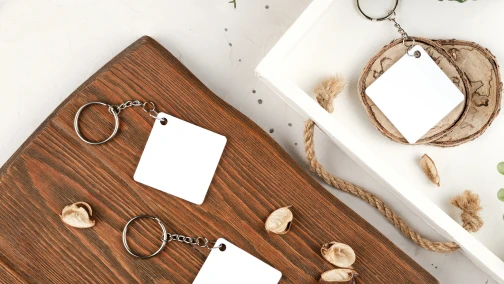
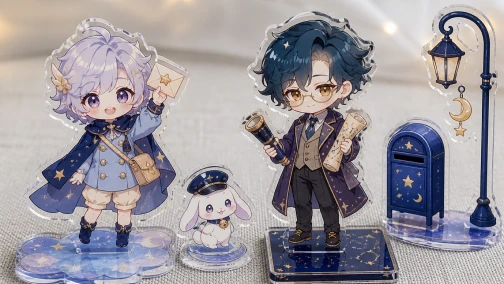
Badges carry the grid, but a finished layout usually mixes formats, and ita bag charms are the second pillar. Acrylic charms hang from interior straps, rings and zipper pulls, adding depth and movement above the flat badge field. Double-sided printing is common practice here because charms swing and rotate on a moving bag, and finishes like holographic film or a glossy epoxy dome catch light through the window. Because charms rub against the clear panel, owners prefer durable surfaces, and many keep the charm inside the window compartment rather than swinging free outside. Custom acrylic keychains in charm sizes, with the right attachment hardware, slot directly into this use case.
Flat surfaces around and inside the bag open two more slots. Dome stickers, with their raised resin finish, work on rigid insert boards, phone cases and water bottles that travel with the bag, and their tactile surface suits premium character goods. Vinyl stickers cover the cheapest display real estate: backing boards, laptop lids, luggage and packaging inserts. A creator who sells badges and charms can use stickers as low-cost add-ons that round out a fan's display setup and lift average order value without complicating production.
Designing an original character set for display
Creators with original characters are well positioned here, because display culture rewards set logic over single items. A practical starter set has a clear hierarchy. The centerpiece is a large badge or oversized charm with the definitive portrait. Around it sit standard badges in three to six variations: different expressions, poses or seasonal outfits drawn to one template so they tile cleanly in a grid. A double-sided acrylic charm adds the vertical element, and a small sticker sheet covers the flat surfaces. Consistent palette and silhouette across the set is what makes a fan's finished layout look designed rather than accumulated.
Made-to-order production fits this model well. A creator can launch with a modest run, watch which expressions sell out first, and reorder the winners without holding deep stock. Because serious buyers purchase multiples of the same design, even a small catalog can generate meaningful unit volume, and pre-orders timed to conventions or character birthdays give a clean demand signal before committing to a larger batch.
Selling into the display market: events and online
The natural sales channels mirror the culture. Conventions and artist alleys are the core venue, with fan meetups, cafe collaborations and online drops filling the calendar between shows. A few practices convert display culture into sales. Bring a demo bag pre-decorated with your own set so visitors see the finished grid rather than loose badges on a table. Offer multi-buy bundles, since buyers already plan to purchase in quantity. Photograph every product listing on an actual bag, because anime badge display photography sells the outcome, and the outcome is what this market buys. Announce restocks and new set pieces on a rhythm tied to events and character milestones, matching the rebuild cycle that drives repeat purchases.
Compliance: whose characters belong on the badges
Itabag culture includes heavy use of fan art based on existing anime and game properties, and sellers should understand the boundary before building a product line around it. Fan art of an existing character is generally a derivative work, and commercial sale carries copyright risk regardless of disclaimers or credit lines. Rights-holder policies vary and change over time, so anyone selling character merchandise should check the current official policy for that property or consult an attorney; nothing here is legal advice.
The durable, low-risk position is original characters and properly licensed designs. Modori Works manufactures custom merchandise from your original artwork or properly licensed IP, and clients are responsible for confirming they hold the rights to whatever they submit. We can work under an NDA when designs are commercially sensitive, and we do not produce unlicensed character goods.
Ordering made-to-order merch for the display market
The ordering workflow for display merch is straightforward if it is planned around an event date. Prepare artwork at print resolution with clean cutlines, confirm a proof before production, and size the first run around pre-orders plus a display buffer. For most creators the sequence is badge set first, charm second, stickers as the add-on tier, then reorders of whatever the grid buyers clear out first.
Itabag culture turns small merchandise into a visible, repeatable, community-driven purchase. If you have original characters or licensed artwork ready for production, start with a badge set built for the grid: explore our custom button pins and acrylic keychains, and request a quote for a made-to-order run sized to your next event.
-

Modori Works Team
Custom B2B Merchandise Manufacturer
Authored by the engineering and production specialists at Modori Works. We share deep manufacturing insights, material breakdowns, and workflow guides to help global brands, artists, and event organizers bring custom acrylics, keycaps, and collectibles to life with strict IP protection.